
Transform Your Agency with Strategic Time Tracking in 2025
Why Does My Agency Need Time Tracking? A CFO’s Guide to Unlocking Profitability and Clarity

It’s a familiar story for agency owners. The team is swamped, new clients are signing on, and revenue is climbing. You’re busier than you’ve ever been. So why does cash flow still feel tight? Why doesn’t the bottom line reflect all the incredible work your team is shipping? If you’ve ever looked at your P&L statement and thought, “This doesn’t feel right,” you’re not alone. This is the agency owner’s dilemma: being busy, but not knowing if you’re truly profitable.
For many creative, marketing, and tech agencies, the mere mention of “time tracking” can trigger a collective groan. It’s often seen as a straightjacket on the fluid, non-linear creative process—an administrative burden that stifles innovation. To your team, it can feel like a tool for micromanagement, a way for “big brother” to watch their every move. And if you’re not billing by the hour, it can seem like a completely pointless exercise.
Let’s reframe the conversation.
Effective time tracking is not about surveillance. It’s about intelligence. It is the single most critical source of business data your agency can have, transforming your leadership from reactive and gut-driven to proactive and strategic. It is the foundational layer for gaining the clarity, confidence, and control you need to scale profitably.
Often, the most painful issues in an agency—like team burnout, high employee turnover, and tense client relationships—are treated as HR or account management problems. But in reality, they are lagging indicators of a deeper financial and operational issue. The chain of events is clear: without historical data on how long projects actually take, scoping is guesswork. This guesswork leads to underpricing and a constant battle with scope creep, where extra revisions and requests slowly erode your margins. The result? An overworked, burnt-out team and a profitability problem that no amount of team-building can fix. Time tracking provides the objective data needed to solve the root cause, not just treat the symptoms.
Part I: The Strategic Shift—From Tracking Hours to Tracking Value
To truly understand the power of time tracking, you have to stop seeing it as an administrative task and start seeing it as a C-suite level strategic tool. It’s not about counting minutes; it’s about understanding the fundamental economics of your business.
Uncovering Your True Profitability: The Difference Between Revenue and Sanity
Top-line revenue is a vanity metric. It feels good to say you’re a “$3 million agency,” but if your expenses are $2.95 million, that number doesn’t mean much. Profit is what funds your growth, your team’s salaries, and your own sanity. Many agencies chase revenue growth while their profitability flatlines because they don’t have visibility into their biggest cost: their team’s time.
Time data is the only way to calculate the true profitability of every client, every project, and every service you offer. It allows you to calculate your “delivery margin”—the profit you generate from client work after the full cost of your team’s labor is accounted for. For example, a flashy $100,000 project that consumes 1,000 team hours might have a lower delivery margin than a less glamorous $80,000 project that only takes 500 hours. Without time data, you might be fighting to win more of the wrong kind of work.
Mastering Your Pricing and Scoping: From Guesswork to Confidence
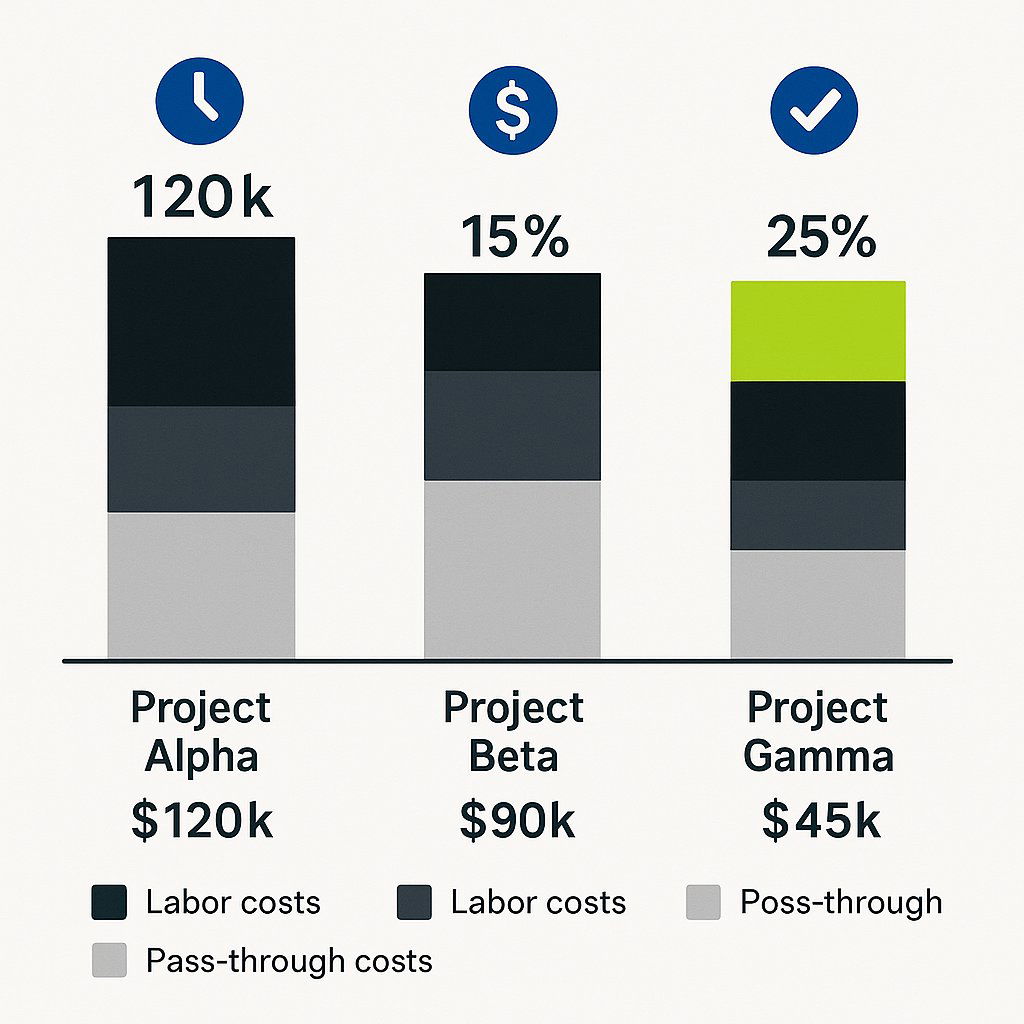
Underpricing is one of the most common and destructive financial mistakes an agency can make. It often happens because, without data, you’re guessing what a project will cost to deliver. Time tracking is the antidote. Having a historical record of the actual hours your team spent on similar projects is the only way to build accurate, data-driven proposals that protect your margins from day one.
This data-backed confidence is also what empowers you to move away from hourly billing and toward more profitable value-based pricing models. When you know your true costs with certainty, you can price your services based on the immense value you deliver to the client, not the hours it takes to produce the work.
Furthermore, it gives you a powerful tool to combat scope creep. When a client asks for “just one more small revision,” you can move the conversation from subjective to objective. Instead of a difficult negotiation, it becomes a simple, data-informed statement: “We’d be happy to. The original scope included 15 hours for revisions, which we’ve used. Our data shows this next round will take approximately 5 additional hours. We can add that to the project for [cost].” This protects your team, your timeline, and your profitability.
Optimizing Your Most Valuable Asset: Your Team
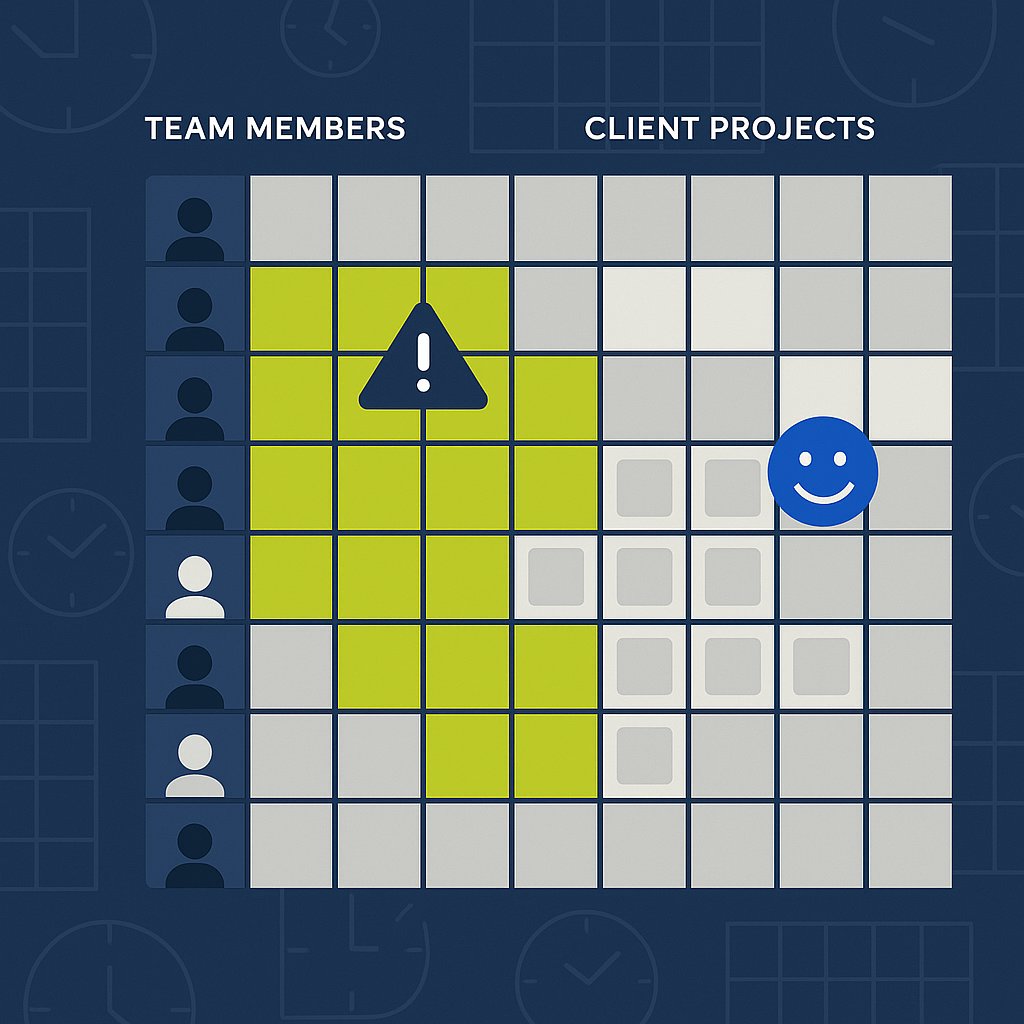
For any agency, your single largest investment and expense is your people. Time tracking is the primary tool for managing that investment effectively. The data it generates provides a clear picture of resource allocation across the entire agency. It instantly reveals who is consistently over-utilized and at risk of burnout, and who is under-utilized, signaling a potential inefficiency or a need to fill the sales pipeline. This allows you to balance workloads intelligently, keeping your team healthy and productive.
This data also transforms performance reviews. Instead of relying solely on subjective feedback, you have objective metrics. You can see an employee’s efficiency, identify their most profitable skills, and find opportunities for professional development. For instance, you might discover a designer who is slower on logo projects but exceptionally fast and profitable when creating website mockups. This insight allows you to channel them toward their highest-value work, benefiting both the employee and the agency’s bottom line.
Part II: The Five Pillars of a Financially Healthy Agency
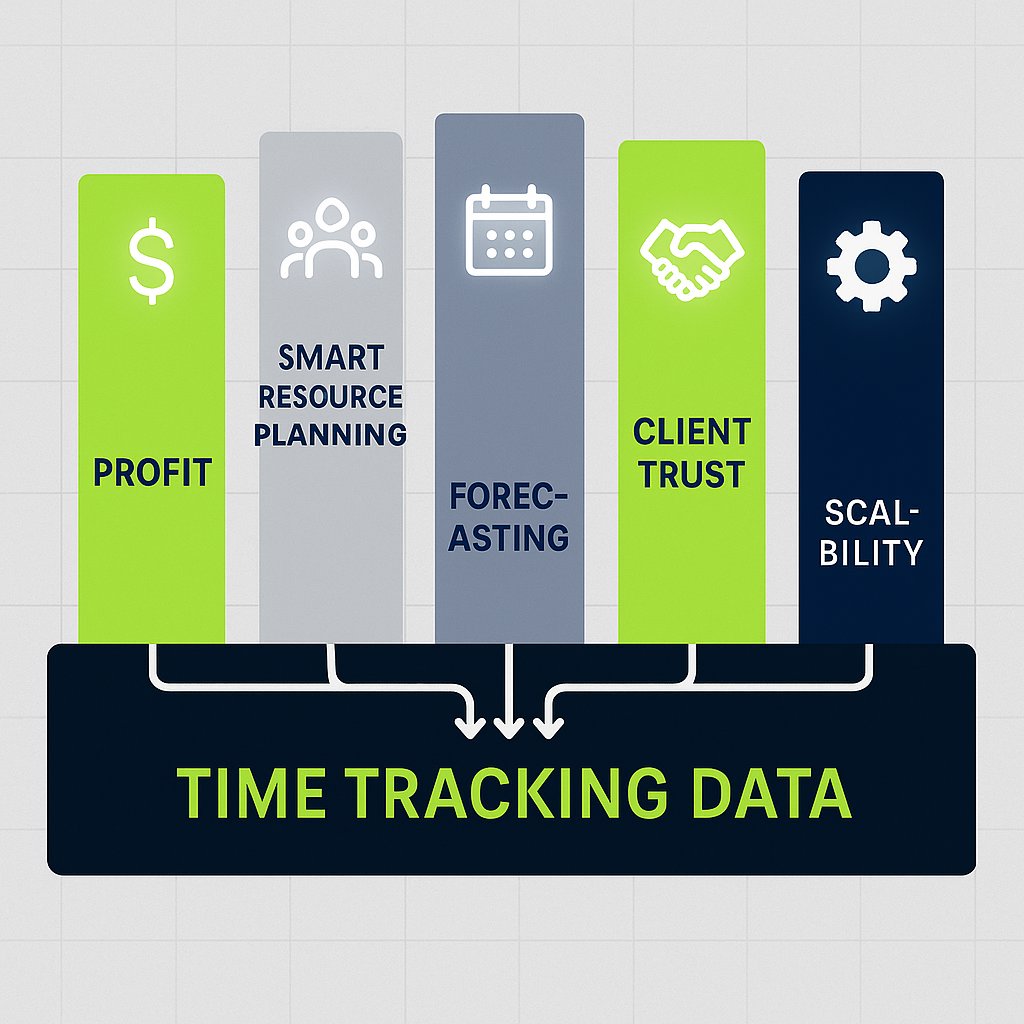
Implementing time tracking isn’t just about collecting data; it’s about building a stronger, more resilient, and more profitable business. The data you gather becomes the foundation for five essential pillars of agency health.
Pillar 1: Crystal-Clear Project & Client Profitability
A standard P&L statement gives you a blended, high-level view of your business. It can tell you if you were profitable last month, but it can’t tell you why. Was it because of Client A, or in spite of Client B? To make strategic decisions, you need granular data. By tracking time and understanding the “fully loaded cost” per employee (which includes salary, benefits, and a share of overhead), you can analyze every project with surgical precision.
This simple analysis can be revolutionary. It moves the invisible cost of your team’s time onto the balance sheet for each project, revealing which clients are fueling your growth and which are silently draining your resources. If you’re not sure your data is strong, accurate data in accounting is essential to give you confidence in your results.
| Metric | Example Project A | Calculation Notes |
|---|---|---|
| Project Revenue | $50,000 | The total fee charged to the client. |
| Pass-Through Costs | ($5,000) | Ad spend, stock photos, contractor fees, etc. |
| Adjusted Gross Income (AGI) | $45,000 | Revenue - Pass-Through Costs |
| Total Hours Tracked | 410 hours | Sum of all team hours from your time tracking tool. |
| Avg. Fully Loaded Cost/Hour | $75/hr | Your agency’s average employee cost. |
| Total Labor Cost | ($30,750) | Total Hours Tracked * Avg. Cost/Hour |
| Net Profit | $14,250 | AGI - Total Labor Cost |
| Profit Margin | 31.7% | (Net Profit / AGI) * 100 |
Pillar 2: Data-Driven Resource & Capacity Planning
Without data, key decisions like hiring are often based on “feeling busy.” Time tracking replaces that feeling with facts. When you can see that your team is consistently operating at or above capacity on billable work, you know that a new hire is not just a cost, but an investment that the business can support and requires to grow.
This data is also crucial for capacity planning. By analyzing past projects, you can understand your team’s true capacity for work, which prevents you from over-promising and under-delivering to clients. It also informs the critical hire vs. outsource decision. If your data shows a consistent need for 15 hours per week of specialized copywriting, for example, it may be far more profitable to bring on a part-time employee than to continue paying a premium for freelancers.
Pillar 3: Accurate Forecasting & Predictable Cash Flow
The “feast or famine” cycle is a classic agency struggle, and it stems from a lack of predictability. When you know precisely how long your projects take and what your true profit margins are, you can forecast future revenue and expenses with a much higher degree of accuracy.
This predictability is a game-changer. It allows you to make strategic investments in new services, technology, or marketing with the confidence that you will have the cash flow to support them. It also provides the perfect tool for managing retainers. With time tracking, you can easily see if a client is consistently using more hours than their agreement covers, giving you clear, undeniable evidence to justify a conversation about increasing the retainer or scoping a new project—and to steer the business toward predictable cash flow over time.
Pillar 4: Radical Client Transparency & Trust
Many agencies view sharing time reports with clients as a defensive move, something you only do when an invoice is questioned. This is a missed opportunity. Proactively sharing simplified reports is a powerful way to build trust and strengthen relationships.
These reports demonstrate the immense value your team is delivering behind the scenes. They justify budgets and build client confidence, turning your relationship from a simple vendor transaction into a strategic partnership. The conversation shifts from “How much does this cost?” to “How can we best allocate our budget for maximum impact?” with you positioned as the trusted, data-informed advisor.
Pillar 5: A Scalable Operational Engine
Finally, time tracking is the key to building an agency that can grow without breaking. The data it generates is a spotlight that illuminates hidden inefficiencies and bottlenecks in your delivery process. Are you spending too much time on non-billable internal meetings? Does the QA phase of every web project take 50% longer than you estimated?
Answering these questions is the foundation of continuous improvement. By identifying and fixing these operational drags, you make your service delivery more efficient. For every fixed-fee project, that increased efficiency translates directly into higher profit margins. These refined, standardized, and data-proven processes create a scalable engine that allows your agency to take on more work without sacrificing quality or profitability.
Part III: The Implementation Playbook—Making Time Tracking Stick
Knowing why you need to track time is one thing; getting your team to do it consistently is another. Success depends less on the software you choose and more on the culture you build around it.
Step 1: Gaining Team Buy-In (It’s Not Big Brother)
The single biggest obstacle to successful time tracking is employee resistance, which is almost always rooted in the fear of being micromanaged. If your team believes the data will be used to punish them for taking “too long” on a task, they will either resist the process or fudge their numbers, making the data useless.
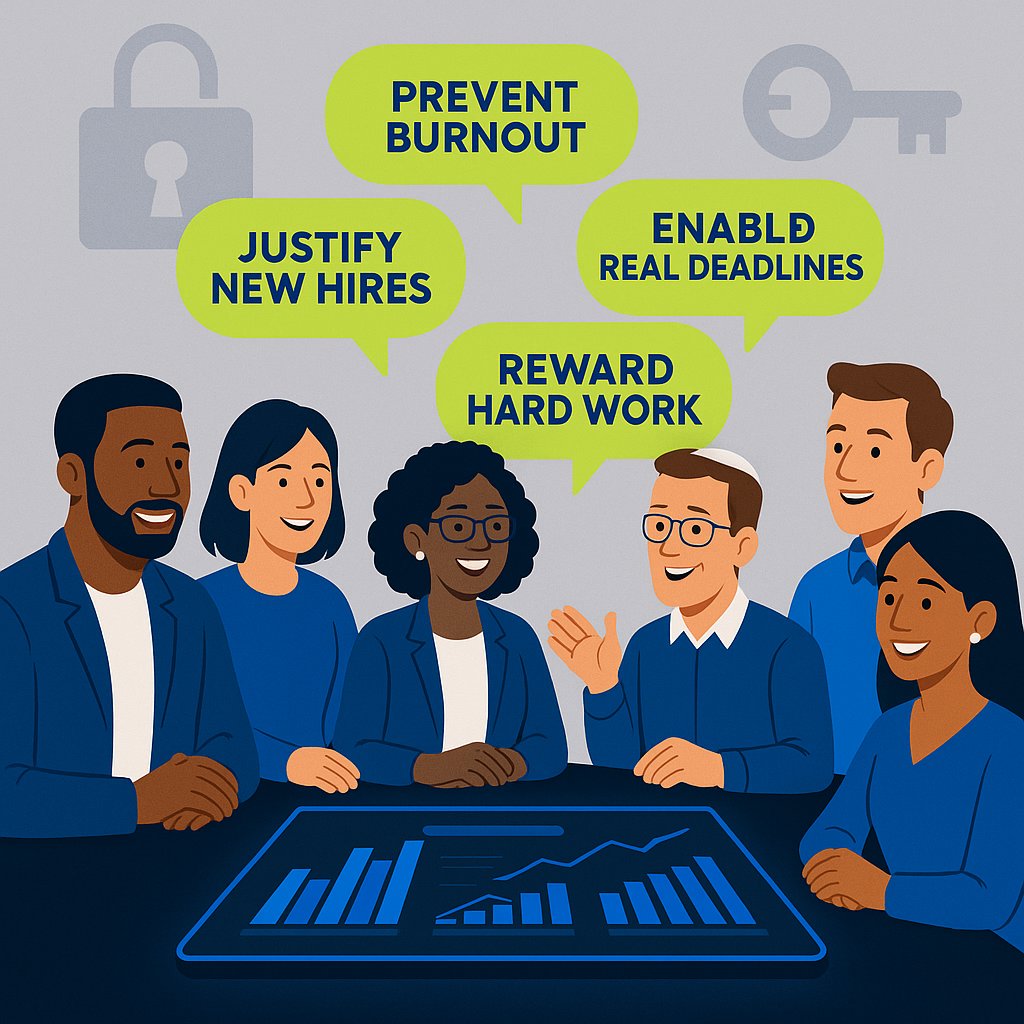
Therefore, the rollout must be framed as a tool for empowerment, not enforcement. The conversation should focus entirely on the benefits to the team. When introducing the initiative, use talking points that address their primary concerns:
- “This is our best tool to prevent burnout.” By making workloads visible, we can see who is overloaded and rebalance tasks before anyone gets overwhelmed.
- “This will help us set more realistic deadlines.” With accurate data, we can stop over-promising and create project timelines that are achievable without late nights and weekend work.
- “This data is how we justify hiring more people.” When we can prove we’re at capacity, it builds the business case for bringing in more help to support you.
- “This helps us recognize and reward your hard work.” Objective data on efficiency and profitability provides tangible evidence to support raises and promotions.
Crucially, leadership must lead by example. Track your own time and be transparent about what you’re learning. When the team sees that time data leads directly to a new hire that eases their workload, they will become your biggest advocates.
Step 2: Designing Your Framework & Choosing Your Tools
Don’t overcomplicate the setup. The goal is consistent adoption, not forensic-level detail. Start with a simple, logical framework that everyone can understand. A great starting point is:
- Level 1: Client
- Level 2: Project
- Level 3: Task/Service Line (e.g., Strategy, Design, Development, Project Management)
- Tag: Billable vs. Non-Billable
When choosing software, user-friendliness is the most important feature. The tool should be simple, intuitive, and feel seamless. Look for solutions that integrate directly with the project management tools your team already uses, like Asana, ClickUp, or Trello. This reduces friction by allowing them to track time without constantly switching tabs. Popular and effective tools for agencies include Harvest, Toggl, and Everhour.
Step 3: From Data to Decisions—The KPIs That Matter
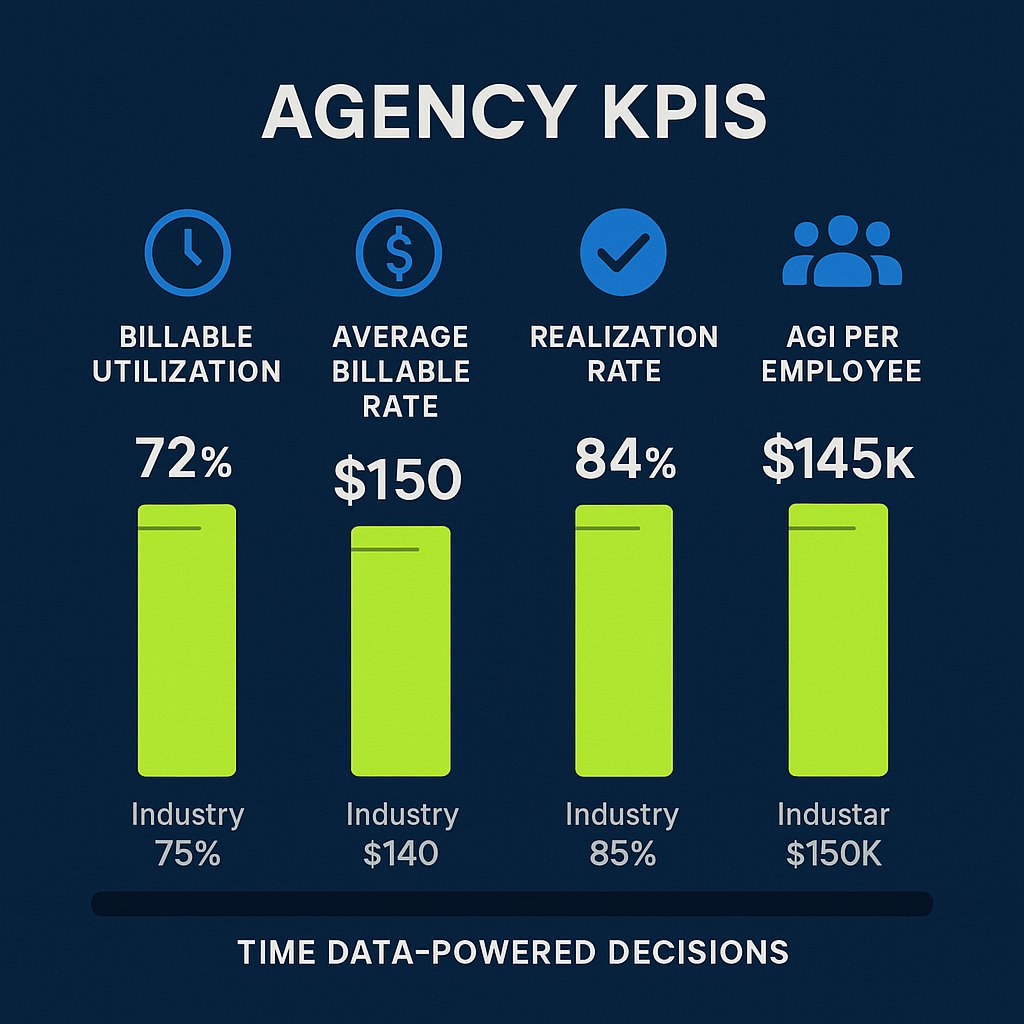
Collecting data is pointless if you don’t use it to make better decisions. By translating raw time data into a handful of Key Performance Indicators (KPIs), you can create a simple dashboard to monitor the health of your agency every month. And if you want to clarify the difference between finance roles, bookkeeper vs accountant vs controller vs CFO can help you understand how each position supports agency analytics and reporting.
| KPI | Formula | Industry Target | What It Reveals |
|---|---|---|---|
| Billable Utilization Rate | (Total Billable Hours / Total Capacity Hours) * 100 |
75-80% | Are we spending enough time on revenue-generating work? A low rate signals inefficiency or overstaffing. |
| Average Billable Rate (ABR) | Adjusted Gross Income / Total Hours Tracked |
Varies by agency | What is the effective hourly rate we earn? This helps identify your most profitable types of work. |
| Realization Rate | (Billed Hours / Billable Hours) * 100 |
>95% | Are we actually billing for all the billable work we do? A low rate indicates scope creep, write-offs, or over-servicing. |
| AGI per Employee | Total AGI / # of Full-Time Employees |
$150,000+ | Is our business model efficient? This is a key indicator of overall agency health and scalability. |
Conclusion: Your Agency’s New Compass
Time tracking is not just another task to add to your team’s plate. It is your agency’s compass. It provides the objective, reliable data you need to navigate the challenges of growth, pricing, and staffing. It gives you clarity on where your profits truly come from, the confidence to make bold strategic decisions, and ultimate control over your agency’s financial future.
Ready to take the first step? Don’t worry about buying and implementing a new tool just yet. This week, ask your team to track their time for a single project on a simple shared spreadsheet. At the end of the project, use the Project Profitability Analysis template from this article to see what the data tells you. The insights will likely surprise you—and set you on the path to more predictable, profitable growth.
Gaining financial clarity is a journey. When you’re ready to turn these insights into a strategic financial plan for your agency, our team at AURA is here to help you read the map.
Citations
- Goodey, Ben. “The Financial Fog: 8 Signs Your Agency’s Underperforming.” Scoro, https://www.scoro.com/blog/agency-financial-mistakes/.
- Petitpas, Marcel. “Agency Time Tracking – The Right Way.” Parakeeto, 23 June 2025, https://parakeeto.com/blog/how-to-track-time-with-marcel-petipas-episode-42/.
- McLellan, Drew. “How to Manage Small Business Finances as an Agency Owner with Jason Blumer.” Agency Management Institute, https://agencymanagementinstitute.com/how-to-manage-small-business-finances/.